WhatsApp: ; Email:
Work
WhatsApp: ; Email:
Work

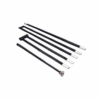
Silicon carbide (SiC), also known as carborundum, is a hard compound containing silicon and carbon. As a semiconductor, silicon carbide particles can be combined through sintering to form a very hard ceramic, hardness approaching that of diamond.
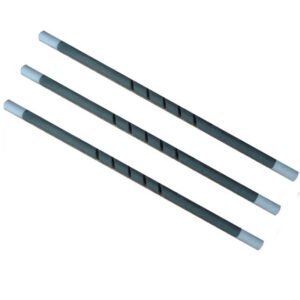
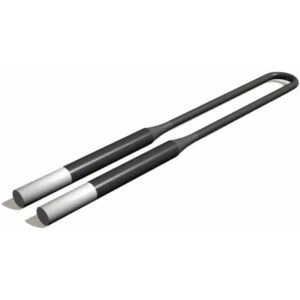
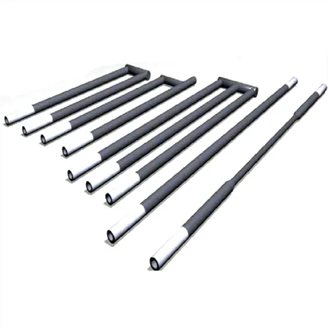
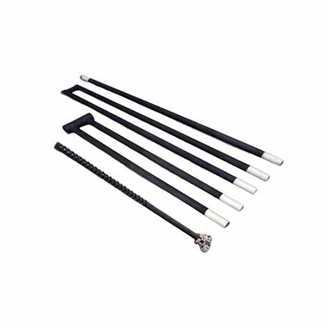
Silicon carbide heating elements, also known as globar sic heating elements or silicon carbide rods, are rod-shaped non-metal high-temperature heating elements made of high-quality green silicon carbide as the main raw material, processed, returned, high-temperature silicified and recrystallized.
Silicon carbide (SiC), also known as carborundum, is a hard compound containing silicon and carbon. As a semiconductor, silicon carbide particles can be combined through sintering to form a very hard ceramic, hardness approaching that of diamond.
Silicon carbide heating elements, also known as globar sic heating elements or silicon carbide rods, are rod-shaped non-metal high-temperature heating elements made of high-quality green silicon carbide as the main raw material, processed, returned, high-temperature silicified and recrystallized.
Features
Accepts significantly higher electrical loadings than metallic
elements
Considerable savings in furnace construction cost
Maintenance is greatly simplified
Available in multi-leg derivative
Advantage
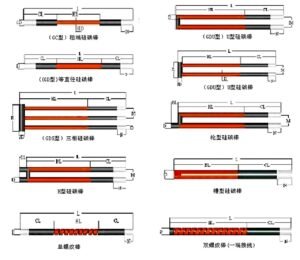
Silicon carbide heating element is a time trusted heating element. It has the advantages of small hot-end resistance, long service life, and energy saving.Silicon Carbide heating elements are available in eight different basic configurations that extend heater life especially in corrosive environments.
Specification
| Material | Silicon Carbide(SIC) |
| Temperature | 200 ℃~1625 ℃ (392℉ – 2957℉) |
| Diameters | 10 mm – 55 mm |
| Hot zones | Max 4.2 m |
| Lengths | 100 mm – 6 m |
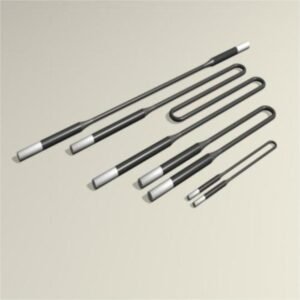
| Shape | slot type, U type, SGR type, SG type, M type, ED type, DB type |
| Coating | Alkali resistant Coating, A Coating, B Coating |
Physical Properties of Silicon Carbide Heating Elements
| Specific gravity | 2.6~2.8g/cm³ | Bend strength | >300kg |
| Hardness | >9MOH’S | Tensile strength | >150Kg.cm³ |
| Porosity rate | <30% | Radiancy | 0.85 |
| Thermal Conductivity | 14-19W/m·℃
(1000℃) |
Specific Heat | 1.0kj/kg·℃
(25~1300℃) |
| Rupture Strength | 50Mpa(25℃) | Coefficient Of Thermal Expansion | 4.5x 10⁻⁵ |
Temperature
Silicon carbide (SiC) heating elements can withstand temperatures up to 1625℃(2957℉), making them ideal for high-temperature applications. We offer a variety of standard sizes and geometries, as well as custom designs to meet specific requirements for various processes and equipment.
Electrical characteristics
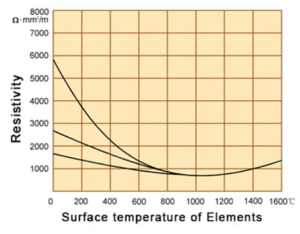
sic heating elements has rather large specific resistance. When it is heated in air and the surface temperature of the hot zone reaches 1050℃(2732℉), its resistance rate is 600-1400 mm²/m. Its resistance value changes as the temperature rises.
From room-temperature to 800℃(1472℉) is negative value, over 800℃ is positive value nature curve.
All silicon carbide elements gradually increase in resistance during their life in operation and the rate at which this occurs is affected by the following factors:
Element type
Element Specific Loading (W/cm²)
Operating Temperature
Process Atmosphere
Mode of operation – continuous or intermittent
Operating practices
Specification and range of resistance:
| Diameter
(OD mm) |
Length of hot zone
(HZ mm) |
Length of cold zone
(CZ mm) |
Overall length
(OL mm) |
Range of resistance
(ohms) |
| 8 | 100-300 | 60-200 | 240-700 | 2.1-8.6 |
| 12 | 100-400 | 100-350 | 300-1000 | 0.8-5.8 |
| 14 | 100-500 | 150-350 | 400-1200 | 0.7-5.6 |
| 16 | 200-600 | 200-350 | 600-1300 | 0.7-4.4 |
| 18 | 200-800 | 200-400 | 600-1600 | 0.7-5.8 |
| 20 | 200-800 | 250-600 | 700-2000 | 0.6-6.0 |
| 25 | 200-1200 | 250-700 | 700-2600 | 0.4-5.0 |
| 30 | 300-2000 | 250-800 | 800-3600 | 0.4-4.0 |
| 35 | 400-2000 | 250-800 | 900-3600 | 0.5-3.6 |
| 40 | 500-2700 | 250-800 | 1000-4300 | 0.5-3.4 |
| 45 | 500-3000 | 250-750 | 1000-4500 | 0.3-3.0 |
| 50 | 600-2500 | 300-750 | 1200-4000 | 0.3-2.5 |
| 54 | 600-2500 | 300-750 | 1200-4000 | 0.3-3.0 |