WhatsApp: ; Email:
Work

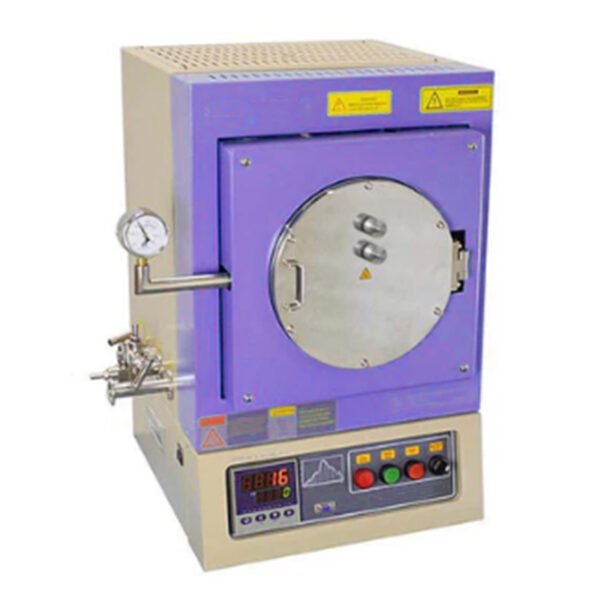
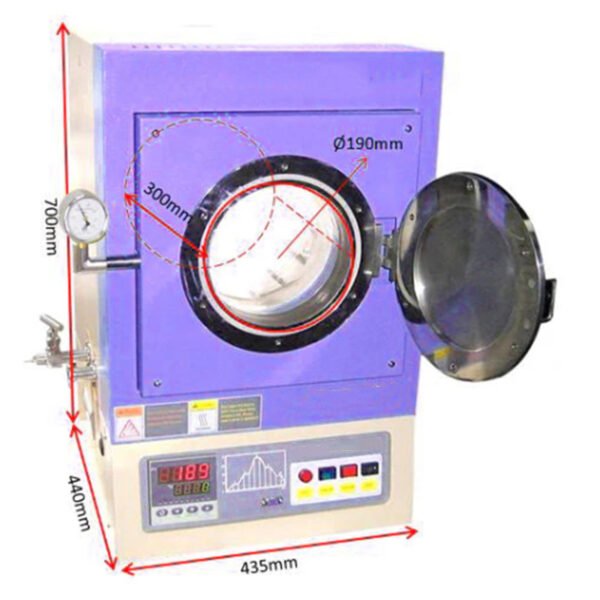
This is a compact vacuum furnace. It equips a 7.5″ ID x 13.4″L Quartz tube chamber sitting horizontally. Water-cooled stainless steel vacuum flanges with valves are installed to achieve a vacuum of upto10-5 Torr via turbopump. It is designed for calcining or annealing semiconductor wafers (up to 6″) under vacuum or various other gas atmospheres with a temperature of up to 1100°C. It also can also be used as a vacuum brazing furnace.
This is a compact vacuum furnace. It equips a 7.5″ ID x 13.4″L Quartz tube chamber sitting horizontally. Water-cooled stainless steel vacuum flanges with valves are installed to achieve a vacuum of upto10-5 Torr via turbopump. It is designed for calcining or annealing semiconductor wafers (up to 6″) under vacuum or various other gas atmospheres with a temperature of up to 1100°C. It also can also be used as a vacuum brazing furnace.
SPECIFICATIONS
| Power | Voltage: Single-phase 208 – 240 VAC / 50/60Hz, (20 A breaker installed)
3.6 KW max. |
| Working Temperature | <= 1000 °C continuously
Max. 1100 °C, < 30 minutes Temperature Uniformity: +/- 2°C Note: <= 1150 °C continuously is available upon request by GE214 grade quartz tube at the extra cost |
| Heating Rate | Max. 20°C/ min
• Recommended. 10°C/ min |
| Heating Elements | High-quality Ni-Cr-Al resistance wire |
| Chamber Dimensions | 240 * 260 mm |
| Quartz Tube & Effective Heating | Tube size: 200 * 340 mm
The quartz tube is replaceable |
| Vacuum Flange
|
Stainless steel water-cooled flange assembly with two quick-connect ports. All of the seals are provided by silicone o-rings.
Multi-function of the quick-connect ports via 1/4″ OD bored alumina tubes. Gas inlet/outlet near the sample surface. Thermocouple feedthrough Optional K type 1/4″ODx18″ L Electric feedthrough. eg. Four probe resistance measurements One bored Al2O3 foam refractory block (190Dia * 50mm) is provided. Thermocouple or electric Alumina Feedthrough (O.D 6.35mm, I.D 4.0 mm, L 300mm) is available upon request Mechanical Vacuum Gauge(included as standard accessory), which ranges from -0.1 to 0.15Mpa. |
| Gas Inlet and Outlet & Water cooling | One gas purging inlet (1/4″ hose adapter ) with a valve is on the left side of the furnace
The inert gas can be introduced into the chamber via the inlet for purging purposes. A water cooling jacket has been built inside the flange to protect the vacuum sealing O-tings. The inlet and outlet ports located on the left side of the furnace are used for connecting to a water chiller through two 12 mm Dia. polyurethane tubes (16L/minute water flow is required). A water chiller is required for heating temperatures above 500°C (thermal block is placed) |
| Temperature Controller
|
NRTL-certified digital temperature controller is included.
Proportional–integral–derivative control (PID control) and auto-tune function 30 segments programmed with ramping, cooling, and dwelling steps Built-in over-temperature alarm and thermocouple failure alarm +/- 1 ºC temperature control accuracy The Default DB9 PC communication port is included for connecting to a PC Eurotherm Temperature Controller is available at an extra cost with +/-0.1°C accuracy. |
| Vacuum Pressure
|
Vacuum Level is dependent on the vacuum pump used, connected pipe, interior refractory block’s materials, etc. By using KFD25, stainless steel pipe, two-stage mechanical pump, and KF25 Ball valve, the furnace can achieve vacuum levels below:
10-2 torr via mechanical pump within 30 minutes 10-4 torr via turbo-pump within 30 minutes with the Quartz Thermal Block at 900C |
| Warning | Tube furnaces with quartz tubes are designed for use under vacuum and at low-pressure < 0.2 bars
Attention: A two-stage pressure regulator must be installed on the gas cylinder to limit the pressure to below 3 PSI for safe operation. Never heat the furnace while the gas release valve is closed when a positive pressure condition exists within the furnace chamber. Max. 1000°C is limited on all quartz tube furnaces under vacuum to avoid the quartz tube’s deformation. The flow rate for gasses should be limited to < 200 SCCM to reduce thermal shocks |